|
Sign up to get 3 free research reports every month →
|
/MODOENERGY%20White.png?upscale=true&upscale=true&name=MODOENERGY%20White.png) | Weekly Dispatch |
Wherever data centers go, batteries will follow US Power Markets Newsletter |
 | Thursday, July 30, 2026 · 7 min read |
|
In last week's Dispatch, I considered the US's evolving battery energy storage map - and had a look at where batteries are being built. The more I think about it, the more I realize there's a deceptively simple answer: they're popping up wherever data centers are. Follow the (large) load - whether that's in PJM or ERCOT - and you'll see new batteries. And that load is extremely large. In PJM, data centers aren't just one part of demand growth. They basically are the demand growth. |
 Source: PJM 2026 Long-Term Load Forecast, via Modo Energy |
Strip out data centers and PJM's peak demand would actually be shrinking - at least until 2032. With them, peak climbs about 97 GW by 2046 - and roughly 78% of that growth is large load, overwhelmingly data centers. |
To learn more about how Modo Energy expects the US battery energy storage market to evolve nationwide, join our livestream next Thursday. |
| | ● Livestream · Aug 6, 2026 · 2:00 PM ET Battery Energy Storage in the US: The Forward Outlook Where build-out, revenues, and prices are heading - across all seven major ISOs and RTOs.  |  | Quentin Scrimshire, CEO
Brandt Vermillion, US Market Lead
|
|
|
And this growth isn't even particularly speculative. 8.2 GW of data centers are already operating in PJM, with another 41 GW contracted or under construction - a fivefold jump already locked in. |
 Source: Utility PJM load-addition filings; PJM 2026 Load Forecast; Modo Energy |
Geographically, it's pretty intensely concentrated: Dominion's Northern Virginia zone alone accounts for a third of the data-center load PJM has accepted through 2030. |
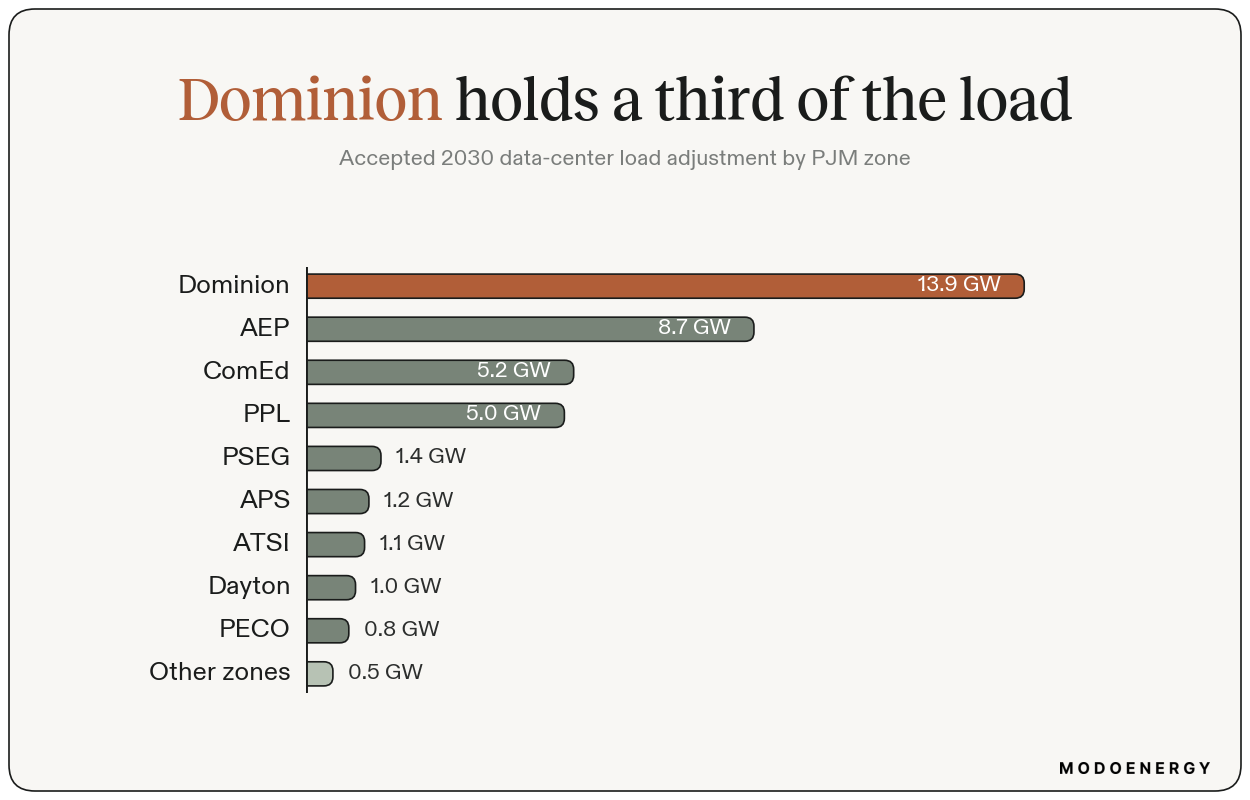 Source: PJM 2026 Load Forecast Report, Modo Energy |
 | Read the full analysis PJM is on track to serve over 1,000 data centers by 2030 Tim Woodruff · 6 min read → |
|
And - surprise surprise - those same zones pulling in the data-center load are exactly where battery developers are now racing to connect. In PJM's latest interconnection cycle, 82 batteries totaling 8.5 GW just cleared a key phase - and Virginia holds the single biggest cohort. |
 Source: PJM Transition Cycle 2 System Impact Studies, Modo Energy |
Why cluster there? Increasingly, the capacity market. PJM capacity prices have hit the cap in each of the last two auctions and - with large-load growth showing no sign of easing - are expected to stay there. That hands batteries a large, dependable revenue stream, and it's richest right where the data centers are landing. (The energy-arbitrage case is murkier - big new loads could widen spreads or compress them - so for now it's capacity, not arbitrage, doing the heavy lifting.) |
That capacity revenue also shapes what gets built. Accreditation is duration-dependent - a two-hour battery earns almost none of it, which is why there's so little short-duration in the cohort, and it scales up the longer you go. Four-hour systems dominate this cycle, but nine ten-hour projects are now moving through. |
 Source: PJM Transition Cycle 2 System Impact Studies, Modo Energy |
But that doesn't mean you should expect to see all those batteries come online. |
 | Read the full analysis PJM's queue: 82 batteries progress via Transition Cycle 2 Aaron Orelowitz · 7 min read → |
|
Batteries drop out of PJM's queue faster than any other tech - a 62% attrition rate by project count, against 50% for non-storage. And that's often down to the cost of connecting, which comes from affected-system reinforcements: grid fixes needed well beyond a project's own point of connection. Interconnection charges range from about $3,000 to $1.9 million per MW (with a median near $151k), and some projects saw their bill jump ten- to seventy-fold between studies - with one's costs leaping from $0.85 million to $62.7 million. |
 Source: PJM Transition Cycle 2 System Impact Studies, Modo Energy |
With those economics, expect to see more queue dropouts. Frankly, this feels backwards. Batteries can act as a major net positive for congestion - they ease the very constraints those network upgrades are built to relieve - so making it prohibitively expensive to connect doesn't make much sense to me. |
|
ERCOT 16.5 GW of BESS built - but growth is slowing |
|
If PJM is just starting to heat up for batteries, ERCOT shows what happens to a BESS market as it matures. Texas has built more grid-scale batteries than anywhere in the US - 16.5 GW and 28.8 GWh by June - but after roughly doubling year-on-year until now, additions are leveling off. In fact, annual fleet growth has fallen from around 100% toward 40%. |
 *2026 is annualized from first-half actuals - what's on pace by year-end, not yet built. Source: ERCOT, Modo Energy |
The pipeline still looks enormous on paper: ERCOT's queue implies 64 GW of batteries by 2032. But Modo Energy's central forecast foresees 40 GW - although the size of that gap will likely depend on how much new load actually shows up. |
 | Read the full analysis ERCOT BESS buildout, Q2 2026: growth is slowing Brandt Vermillion · 7 min read → |
|
 Note: Queue-implied projection applies per-stage historical completion rates; Source: Modo Energy July 2026 ERCOT Outlook |
Enter data centers. Modo Energy forecasts an additional 35 GW of demand at peak on the ERCOT grid by 2035, driven by new data centers - more than a third of ERCOT's all-time system peak, itself only just set at around 91 GW last week. That flat, round-the-clock load is a major reason stalled queue capacity could move back into the buildable pipeline. |
The rules that decide whether that data center load connects are now taking shape. Texas's Senate Bill 6 (signed June 2025) makes large loads pay to play - study fees, non-refundable interconnection fees and deposits - and requires any site energized after the end of 2025 to accept remote curtailment by ERCOT in emergencies. |
On top of that, the PUCT's new “Batch Study” process (approved June 2026) replaces one-by-one studies with a single system-wide study of every load of 75 MW or more, with results of the first batch due around spring 2027. The net effect: a higher bar that should weed out speculative entries - but also a hard gate before megawatts move from queued to buildable. |
With that uncertainty - plus a 70%-plus slide in battery revenues since 2023 and longer, costlier build timelines - attrition rates are growing for batteries. |
 Source: ERCOT, Modo Energy |
A record 13.7 GW left ERCOT's queue in the first half of 2026 - including 2.3 GW that had already signed an interconnection agreement. That isn't down to demand. It's the difficulty of financing projects while it's unclear when - or whether - merchant revenues will recover to investable levels. But stronger demand - say, from data centers - could certainly change this picture. |
|
And that's it from me this week. As ever, reply and tell me what you want more of - I read every response.
- Neil US Power Markets, Modo Energy · LinkedIn |
A free Modo Energy account unlocks 3 subscriber-only articles a month. Including everything linked above. No credit card, no demo call.
Modo Energy · Weekly Dispatch, US edition
|